
Milo Zinser-Trudel, Reporter
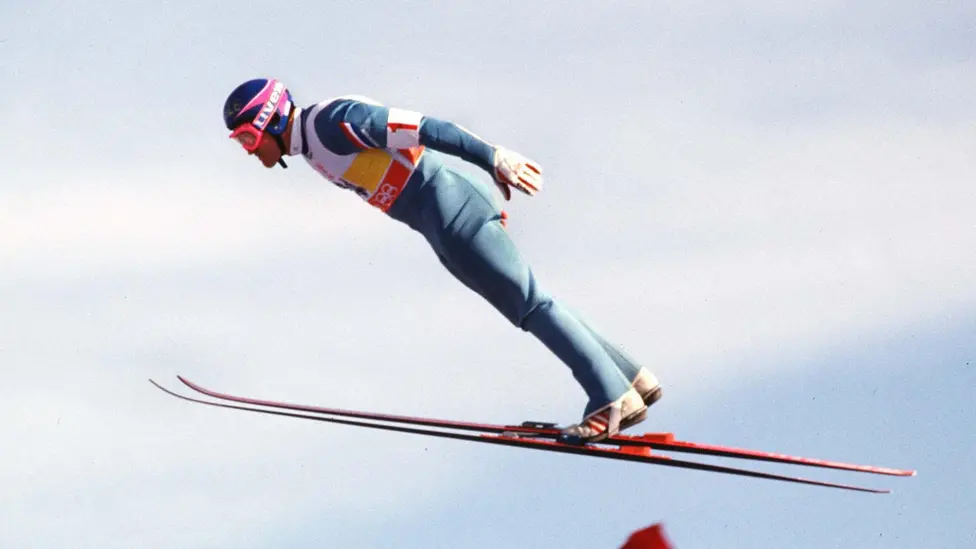
Featured Image: Michael Edwards at the 1988 Olympics (Getty Images)
With the 2026 Winter Olympics underway in Milan, nearly 3,000 athletes are finally competing on a stage they’ve worked their whole lives to reach. Whether they compete in mainstream sports like hockey or more obscure events like the biathlon (cross-country skiing plus target shooting), monobob (one-person bobsled), or skeleton (whatever this is), these people represent the absolute peak of human athleticism and skill.
The viewing public, however, often seems to miss that. In 2024, a poll showed that 27% percent of British adults believed that they could qualify for the 2028 Los Angeles Games with only four years of training. If reading the news frequently has taught me anything, it’s to never underestimate the depths of human delusion. Still, that statistic represents an absurd level of overconfidence that people have in their physical ability.
Seemingly normal people have managed to qualify for the Winter Olympics before. Michael Edwards (a.k.a. Eddie the Eagle) represented Great Britain in ski jumping in 1988, while American Elizabeth Swaney represented Hungary in freestyle skiing in 2018. Edwards qualified almost entirely by virtue of being the only British ski jumper and was notably disadvantaged by being around nine kilograms (twenty pounds) heavier than the next-heaviest jumper. After his Olympic appearance, the International Olympic Committee (IOC) instituted the “Eddie the Eagle rule,” a set of requirements aimed at making sure Olympians were actually qualified to be there.
Swaney, an Oakland native who had previously attempted to run for governor of California and then to compete in Skeleton for Venezuela at the 2014 Olympics, found the rule’s flaw. The specific requirements for women’s freestyle skiing mandated a minimum number of top-30 finishes at international events. Swaney achieved thirteen of them by attending events with fewer than 30 skiers. She was also aided by the IOC’s quota rules, which prevent individual countries from dominating a sport by allocating spots to National Olympic Committees instead of specific athletes. Team USA, for example, had six skiers ranked in the top 20 worldwide, but only four spots. These factors resulted in Swaney, the world’s 34th-ranked skier, “earning” a spot.
Needless to say, both Edwards and Swaney placed last in their events. Edwards was more than ten meters behind the second-to-last jumper, and Swaney barely attempted to actually perform tricks. However, these weren’t completely unskilled athletes. Both performed far better than almost all of the respondents to the British survey likely could.
There’s a clear way to show how wrong those aspiring athletes are: give some of them a chance to compete. How many people in living rooms worldwide have watched Olympic curling and said, “I could do that“? How many snowboarders think they have world-class skill?
For a few million dollars, the IOC or one of its TV affiliates could pay for a normal person to train for four years for a spot in the Olympics. Set up a raffle, and pick one lucky maniac (bonus points if they don’t get to choose their event). Maybe you compete in curling, maybe you have to figure out a way to do ski aerials without dying. I can’t speak for the rest of America, but I would absolutely watch a reality show following these (un)lucky “athletes.”
This should happen with one key condition: they have to go first in their event. That way, once the most catastrophic—but perhaps most entertaining—part of the event is over, the real athletes can compete, and the spectators can see the actual size of the gap between themselves and the Olympians on TV.