
Leah Granskog, Blogs Editor
On November 12, 2025, the U.S. Treasury suspended the production of the penny. According to the United States Mint, their decision was driven “by the rising cost of producing the penny, which has increased from 1.42 cents to 3.69 cents per penny.” They believe that it is “no longer necessary to meet the needs of the United States.” While it can still be used in transactions, this copper one-cent coin featuring a portrait of President Lincoln will cease to be manufactured again.
To most, except maybe a few coin collectors, cash connoisseurs, or the hundreds who gathered at the Lincoln Memorial on December 20, 2025, for a mock penny funeral, this development had little impact.
Why? It’s because for many Americans, the penny, and arguably cash itself, has already been dead for a while. Whether it be credit or debit cards, or the increasingly popular mobile payment options like Apple Pay, cash seems to be a less frequent choice as a means of payment by American consumers.
According to Payanywhere, as of 2024, 53% of Americans used digital wallets more often than traditional payment methods. That same year, U.S. users spent on average $3,693 via mobile payments, an 87% increase since 2020.
Even if it may seem as though cash is becoming useless, will there truly be a point when cash ceases to exist? Will the government soon also see it as “no longer necessary to meet the needs of the United States?”
The Benefits of Going Digital
Without a doubt, there would be some benefits to a cashless society. From an environmental standpoint, for example, a cashless society could be favorable. The agricultural space and resources required to grow the cotton that makes up our cash, the mining of metals for coins, the use of energy in the manufacturing process, and the emissions released when this money is transported all take a toll on our environment. If we eliminate cash, we will also be reducing the use of these resource-intensive processes.
This is not to say, however, that digital forms of payment don’t come with their own environmental consequences. Of course, these platforms also use a substantial amount of energy and generate a considerable amount of waste. Generally speaking, however, online forms of payment hurt our environment (at least slightly) less than the manufacturing of cash.
Another benefit is simply the convenience that a cashless society would allow when making transactions. No longer would employees have to spend a few extra seconds organizing registers, nor would consumers have to take time rifling through their wallets. Forgetting to bring cash would no longer hinder someone from making a purchase, nor would not having coins to pay in a public parking lot mean an almost-definite ticket.
More often than not, when I’m at a store or restaurant, the screen with which to swipe my card or tap my phone is turned to me before I am even asked how I plan to pay. Pressing a button on a computer is much quicker than the mildly agonizing trouble of making change, and most employees either seem unfamiliar with, or even impatient about, dealing with cash. Cashless payments are quickly becoming the social norm, and those who refuse to adapt will be left with frowns from employees as they wipe the dust from their registers to make change.
The Risks of a Cashless Society
However, a cashless society has its drawbacks as well. For starters, consumers’ spending habits change depending on what form of payment they are using. According to Forbes, consumers are twice as likely to spend when using credit cards or other forms of online payment than when they pay with cash.
If you think about it, this makes sense – cash is tangible worth, and as consumers physically let go of it to buy something, their purchase registers. Tapping a phone or swiping a card, however, causes less physiological “pain.”
This, in turn, could lead to overspending. Whereas you might think twice about buying a $600 luxury item that would require you to use all of the cash you have handy, the hesitancy may be lessened if purchasing it meant simply taking money out of an account.
Another concern in a cashless society is a lack of privacy and security. Essentially, if everyone’s finances are entirely online, it makes cybercriminals’ jobs much easier and increases consumers’ vulnerability to cybercrime and online financial scams.
Similarly, transitioning to a completely cashless society means putting immense trust in the companies that hold our money and financial data. Whereas holding cash gives consumers a sense of control, this control is sacrificed when we entrust these online companies with our information. A crash of one of these online payment systems could have serious economic consequences.
On the other hand, however, a cashless society would mean that other money-related crimes, such as theft or money laundering, would decrease. It’s a “pick your battle” sort of situation, but the question “would you rather your money be stolen via theft or an online scam?” is one that not many consumers have an answer to.
Will Cash Die with the Penny?
So, to me, the question “Will cash die with the penny?” seems to be based not only on consumer purchasing tendencies, but on the businesses and companies to whom we give our money. If salespeople continue to shove card readers at us whenever we buy something, or give us the option to pay for parking via our phones instead of standing in the elements to put coins in a meter, then maybe the answer is yes, that cash will one day become obsolete.
But, a truly cashless society, one where there exists no money fluttering out of birthday cards, no small bills left on restaurant tables for tips, no throwing change into a wishing well, and no exchanging of crumpled bills to buy food from street vendors in the city, is hard to imagine. Especially for those who can’t afford to use online forms of payment, don’t understand how to use these services, or choose not to lend their information to these companies, cash remains an essential part of their lives and how they are able to provide for themselves.
So, whether this cashless society becomes a reality or not is dependent on our wants, both as consumers and as the suppliers and sellers of goods. Will we choose modernization or tradition? Convenience or custom? Digital or physical?
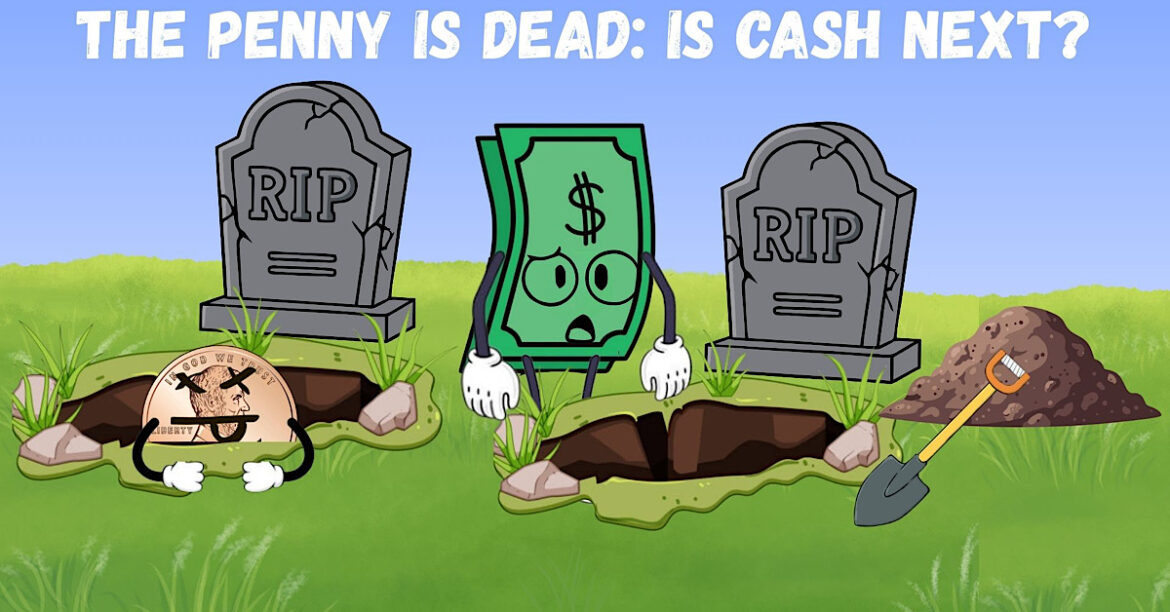
Whether by societal pressure or by choice, we must keep in mind that every cashless purchase we make is pushing cash closer and closer to a tombstone right next to the penny.