
Lucy Paine, Managing Editor
Graphic by Victoria Trembley
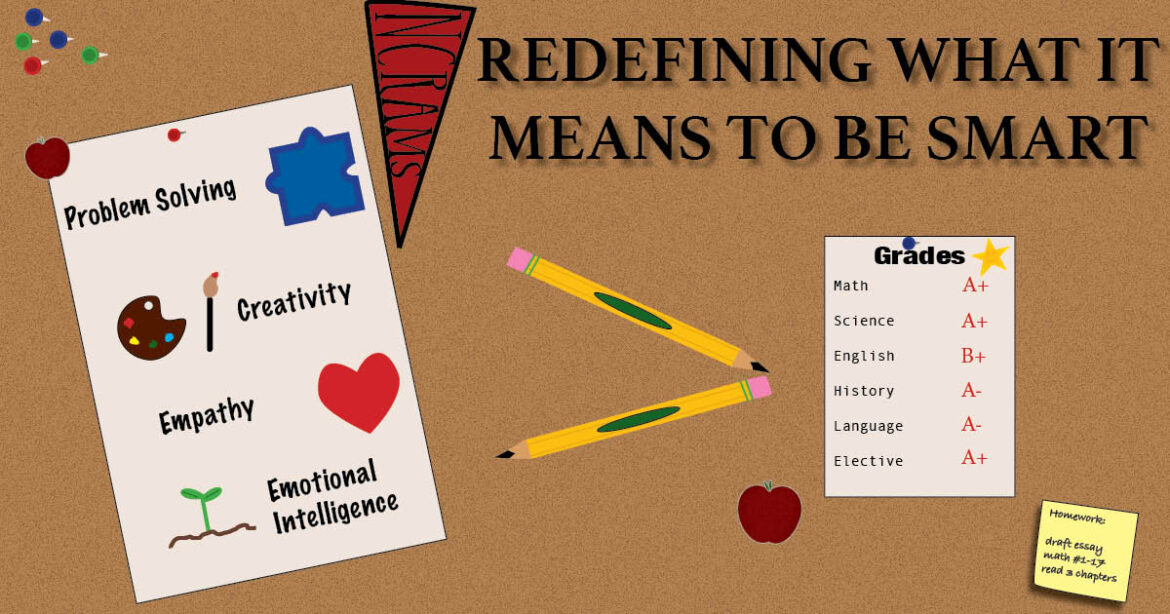
The notion of being “smart” has long been treated as something simple, straightforward, and measurable: a number on a transcript, a GPA calculated to two decimal points, a test score ranked against peers.
But the reality is far more nuanced. Intelligence, as experienced by students in high school today, is not simply about how well one solves equations, memorizes historical dates, or scores on a standardized test. Rather, it encompasses creativity, emotional intelligence, adaptability, and curiosity, qualities that do not appear in any grade book. In a world where academic achievement is often emphasized above all else, students increasingly feel caught between the expectation to excel in measurable ways and the understanding that true intelligence is broader, deeper, and more human.
Junior Macyn Callahan agrees with this idea. “The first thing I picture when I hear the word ‘smart’ is someone with straight A’s and perfect grades, but that definition doesn’t really fit real life,” she said. “There’s a whole layer of intelligence that never shows up on a transcript,” pointing out how schools and society more broadly reward quantifiable performance, sometimes at the expense of recognizing other essential skills. For many students, this misalignment between what is celebrated and what actually constitutes intelligence creates constant self-doubt, especially for those whose strengths lie outside traditionally academic arenas.
But recognizing non-academic intelligence does not erase the social and emotional pressure students experience. “Just because someone learns differently or takes longer to understand something doesn’t mean they’re not intelligent,” Junior Vivienne Zuwiyya said, underscoring how traditional metrics often fail to capture individual strengths. Principal Bill Egan agrees, “Learning is so much more than grades. Life is more than grades. That’s why traits like adaptability, empathy, curiosity, creativity and critical thinking matter so much,” he said. Both students and administrators acknowledge that while systems and initiatives attempt to broaden perspectives, the cultural fixation on grades and measurable outcomes remains entrenched, shaping students’ sense of self-worth.
The Emotional and Human Dimensions of Intelligence
Students like Macyn often experience moments of clarity that highlight these overlooked aspects of intelligence. She talks about helping a friend through a difficult situation and realizing she knew exactly what to say and how to handle it. “Sometimes my brain just clicks, and it reminds me that intelligence isn’t only about studying,” she said. Moments like these, when someone can read emotions, de-escalate tension or offer real support, reveal a kind of intelligence that can’t be measured. It shows up in empathy, judgment and the ability to navigate complex human situations-qualities that matter just as much as anything learned in a classroom.
Emotional intelligence, which encompasses self-awareness, empathy and relational skills, emerges as a particularly powerful component of intelligence that traditional evaluation often misses. Mr. Egan observes that emotional intelligence shows up in how students communicate. “Looking someone in the eye, staying in a conversation, showing curiosity, and being kind. That stuff doesn’t show up on a report card,” he said. For students, these qualities define the kinds of success that matter in both personal and professional contexts. “Emotional intelligence honestly impresses me more than someone who just gets good grades,” Macyn said, echoing the sentiment that navigating human relationships is a sophisticated, valuable and often invisible form of intelligence.
Perhaps the most human aspect of intelligence is the combination of competence and character. “Can you be smart and have no moral compass? The ability to make good decisions is part of being smart,” Susan Carroll, College and Career Center Coordinator asks. Mr. Egan similarly emphasizes that true intelligence includes caring for others. “What sets this community apart is that people care. When someone is in need, everyone rallies. That’s emotional intelligence. That’s being smart in a way you can’t measure,” he said. These qualities demonstrate that intelligence is inseparable from ethical judgment, social awareness and empathy, traits cultivated over time and through real-world experience, not just academic study.
This pressure is not without consequence. “At our school, people compare themselves constantly, and it gets in your head… you start thinking that’s the only way to show you’re smart,” Vivienne said. The constant self-surveillance, combined with the social comparison of GPAs and standardized test scores, contributes to stress and a sense of inadequacy. Yet these pressures coexist with the recognition, by students and educators alike, that real intelligence is richer and more complex than what a transcript can convey.
Educators’ Perspectives on Real-World Intelligence
Teachers and administrators recognize the same truths. Ms. Carroll explains that intelligence extends well beyond academic scores. “The ability to read people, to listen, to pivot, to communicate—that’s real intelligence. Students’ success often hinges on these soft skills rather than on grades alone,” She said.
She also stresses that soft skills matter more than ever. “The job market is changing, and the skills that set you apart aren’t testable,” she said, emphasizing the importance of seeing intelligence as multifaceted. Whether a student can empathize, collaborate, or innovate matters just as much as mastery of traditional subjects.
Mr. Egan echoes this perspective, “I’ve known kids who were total geniuses and went to Ivy League schools, but they couldn’t talk to people. To me, communication and understanding others matter just as much as anything academic,” he said.
He frames intelligence as both intellectual and emotional, highlighting traits such as empathy, resilience and adaptability. “The people who are the smartest aren’t the ones who never mess up. They’re the ones who are resilient and adaptable, who learn from mistakes and come out better because of them,” Mr. Egan said. In his view, the capacity to navigate challenges, reflect on missteps and engage meaningfully with others is foundational to real intelligence.
Furthermore, creativity and adaptability are critical components of being “smart” in a modern, complex world. Harvard research identifies creativity, originality and initiative as top skills for emerging professionals, emphasizing the importance of risk-taking, problem-solving, and innovation. Ms. Carroll underscores this, noting that “the ability to be creative and think outside the box—that’s how you’re going to do well at work.” Both students and educators understand that intelligence is a living, evolving quality that adapts to circumstances and challenges rather than a static property recorded in a gradebook.
Even within high school, students encounter numerous opportunities to develop these essential qualities. The Portrait of a Graduate allows students to reflect on projects that highlight growth in communication, critical thinking, curiosity, adaptability, and empathy. “We wanted our graduates to look like people who could succeed when the future is unpredictable—creative, empathetic, communicative,” Ms. Carroll said. These initiatives reinforce the idea that intelligence is multidimensional and that academic grades, while important, are only one lens through which to view a student’s potential.
The System, the Pressure, and the Need for Change
The broader system that students inhabit, however, often reinforces a narrow vision of success. From colleges to societal expectations, the emphasis on test scores and advanced coursework can create the impression that intelligence is a uniform, measurable commodity.
“We’re part of a system that emphasizes scores, APs, SATs, all of it. College Board makes money off of that pressure. Colleges use those scores. Schools get ranked by them. It all feeds into the mindset students feel,” Mr. Egan said. In this context, students internalize pressure not only from their own ambitions but from a complex ecosystem that equates academic performance with personal worth.
The disconnect between effort and evaluation amplifies this issue. A New York Times opinion piece highlights how some students believe that sheer effort should guarantee high grades, a misunderstanding of growth mindset principles. While a growth mindset encourages resilience and persistence, society’s overemphasis on effort has led students to equate long hours and hard work with inherent worth. “Students put pressure on themselves. They’re too concerned with what the person next to them is doing, and it doesn’t make them any smarter,” Ms. Carroll said. She also emphasizes that intelligence cannot be reduced to numerical outcomes: “You can have a 101 average and great SAT scores, but it’s only through conversation that you find where a person’s heart is,” she said.
Recent efforts to broaden the definition of intelligence offer some guidance. Here, the Portrait of a Graduate initiative allows seniors to demonstrate growth beyond grades through reflections on pieces of work that exemplify traits like empathy, adaptability, communication, critical thinking, and curiosity. Students choose work ranging from art and performances to engineering and science projects, using reflections to show how these experiences demonstrate growth over four years.
These initiatives align with research on how intelligence manifests in professional and adult life. Harvard University identifies key skills emerging as critical for modern careers: analytical thinking, creativity, active learning, emotional intelligence and problem-solving, among others. In an environment increasingly mediated by technology, employers value human capabilities such as leadership, curiosity, and adaptability more than technical skills alone. Ms. Carroll reinforces this point. “These are skills you hone, not something you just get from a transcript,” she said, highlighting that intellectual growth is ongoing and multidimensional.
Ultimately, understanding intelligence as a complex, human trait requires a shift in both mindset and measurement. Students need to recognize that their worth is not defined solely by GPA or test scores. Mr. Egan stresses this idea, “I want every student to know they matter. Their grades don’t make them matter. Their test scores don’t make them matter. What matters is who they are as a person,” he said.
Similarly, Macyn urges recognition of the intelligence that emerges in everyday problem-solving, creative thinking, and emotional awareness. “Not everyone fits the mold of the ‘perfect student,’ but that doesn’t mean they’re not smart,” she said.
In a society that increasingly prizes quantifiable success, students and educators alike are realizing that the richest forms of intelligence often resist measurement. Empathy, resilience, creativity and curiosity define the kinds of adults who will succeed not just on paper but in the unpredictable, interconnected, and ever-changing world. Efforts like the Portrait of a Graduate and the acknowledgment of soft skills in the professional sphere signal a growing recognition that intelligence cannot, and should not, be reduced to numbers alone. High school students may struggle to see themselves as “smart” in a system dominated by grades, but the truth is that intelligence is everywhere. Visible in how students navigate relationships, solve problems, think critically, and adapt to challenges.
By embracing a broader understanding of intelligence, students can begin to appreciate their strengths beyond the transcript. They can celebrate creative insights, interpersonal skills, and curiosity with the same recognition traditionally reserved for test scores. As “The people who are the smartest aren’t the ones who never mess up,” Mr Egan said. “They’re the ones who are resilient and adaptable, who learn from mistakes and come out better because of them.” In the end, being smart is not a number. It’s a set of qualities, skills, and habits that allow students to thrive academically, emotionally, and socially. Recognizing and cultivating these traits ensures that the next generation is not only accomplished on paper but prepared for the complexities of life beyond high school.