
Isla Roen, Story Editor
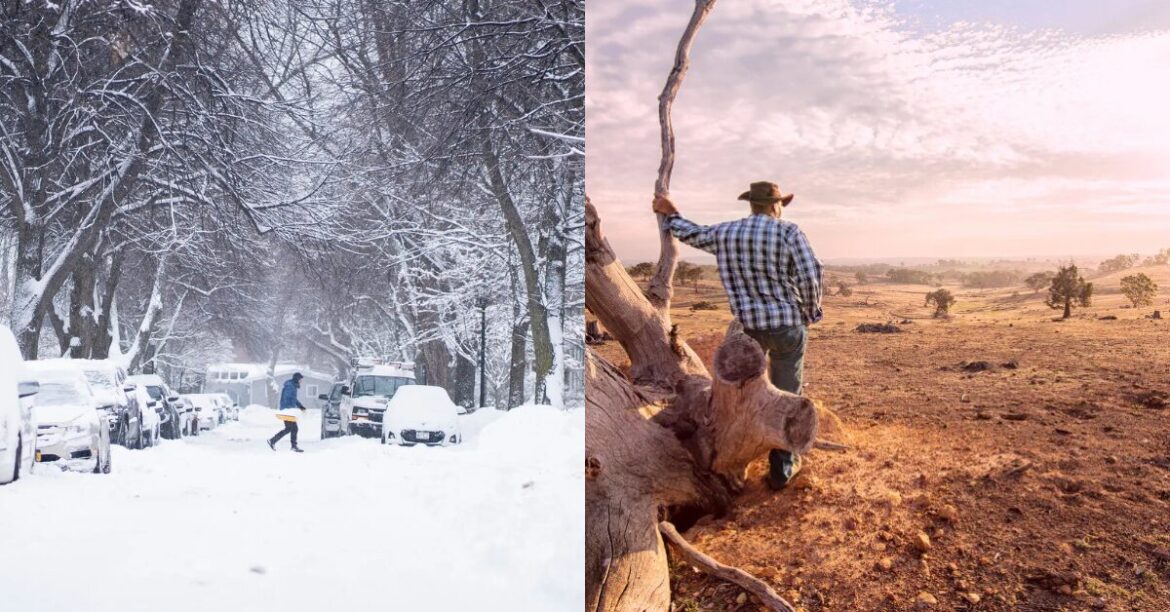
On January 25, 2026, the north east of the United States experienced a large winter storm that left thousands of people without power, brought sub-zero wind chills, and dumped multiple feet of snow across New England. On February 22, New York experienced it’s first blizzard since 2016, with temperatures staying below freezing. Many Americans have been viewing this cold as reassurance that climate change may not be as detrimental as scientists have been warning.
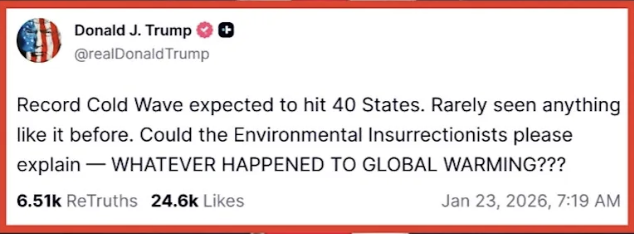
Donald Trump was among the Americans that expressed their suspicion. On Truth Social, President Trump wrote, “Record Cold Wave expected to hit 40 States, WHATEVER HAPPENED TO GLOBAL WARMING???” Donald Trump has a following of over 8 million people on Truth Social, and the post itself ultimately received more than 30 thousand likes.
But the reality is, what happens in parts of the US over six weeks isn’t what’s happening across Planet Earth. And the fact that it’s cold where we are doesn’t mean that temperatures aren’t extremely high elsewhere. On January 27, 2026, just two days after our massive winter storm, Hopetoun and Walpeup in Victoria state, Australia, set records with temperatures as high as 120 degrees. It’s important to remember that the world is much bigger than just the United States, and just because we are experiencing a cold stretch doesn’t mean that the issue of climate change has just disappeared.
And while our northern states are in an intense winter, even farther north, the North Pole, has temperatures 36 degrees above average. As ice accumulates on our roads, snow turns to slush in what is meant to be one of the coldest places on Earth. So “whatever happened to global warming?” is a quick Google search that serves as a reminder that it never left. In fact, it is happening right in front of our eyes.
Unfortunately, scrolling through Truth Social seems to be an easier method for many Americans to receive news than putting something into Google. The difference between the New York Times and President Trump’s social media posts is that he blasts information that helps him, not the environment, and in many cases, not you.
Donald Trump’s motivation is often based upon the abundance of money. How much revenue can he extract for himself and how quickly can he acquire it. And although Trump is benefiting from Trump’s plan, he often leaves a trail of destruction in his path for others, whether they can see it or not.
You may be familiar with Trump’s campaign “Drill, Baby, Drill.” Trump told Americans that this new effort “will cut your energy prices in half within 12 months.” This was a major area of his campaign, and was a huge reason why so many Americans supported his re-election in 2024. And Trump did get elected as he wanted, but failed to fulfill this claim with increased electricity bills by 6.7%. To put it into perspective, new Connecticut electricity bills in Trump’s presence have prices soaring to over $330 per month compared to an average of “more than $200 per month in 2024” according to Yankee Institute.
So not only did “Drill, Baby, Drill” leave Trump’s promises undelivered, but efforts also cut the sales of electric vehicles and offshore wind projects. Both of these were put into action to contribute to a cleaner environment.
Just because a snowstorm swept across the United States in January does not mean we should just turn our head to scientific facts that have taken years of collective evidence to reach. The problem at hand requires a broader understanding of the world at large as well as the motives of the people in charge.