
Graham Jackson, Reporter
Featured Image by Graham Jackson
With higher prices, tariffs and recent funding issues for SNAP benefits, the issue of food insecurity is a serious issue for many Americans. New Canaan and NCHS aren’t spared from these issues either.
NCPS Director of Food Services Michelle Santelli, who oversees the cafeterias across the district, discussed the free and reduced price lunches for underprivileged students. “Over the past two years NCPS has seen a 3.73% increase in qualifying free and reduced students. As of October, we already have 141 students enrolled, which suggests we may continue to see steady growth this year as well,” she said.
Ms. Santelli also discussed how NCPS manages to fund its free and reduced lunch programs. “ NCPS does not receive any funding from the state for school meals. The NCPS Food Services Department is a self-operated entity that generates its own revenue and operates with a profit. It does not rely on state or federal subsidies, including those tied to the National School Lunch Program,” she said. This allows NCPS to provide free and reduced lunches to students in New Canaan who struggle with security in its own capacity.
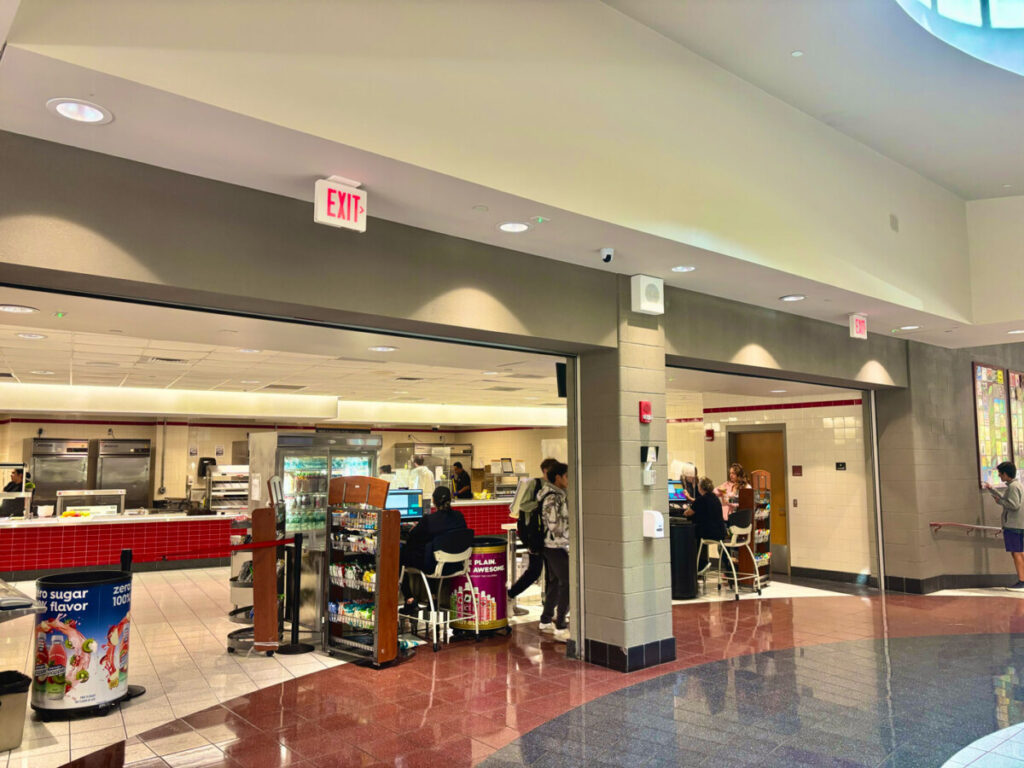
Photo by Graham Jackson
In addition, despite price increases in food, NCPS cafeterias have managed to keep their prices relatively stable. “NCPS has been able to maintain strong revenue due to consistently high participation rates across our cafeterias,” Ms. Sentelli said. “This has helped offset the increased costs. We also implemented a price increase two years ago to help address the effects of inflation. So far, this has allowed us to continue providing meals without compromising quality or service.”
According to Ms. Santelli, out of the over 4,000 New Canaan students, only 141 qualify for free and reduced lunch, or about 3.6%. Additionally, Connecticut Foodshare says about 9.2% of all New Canaanites are food insecure as of May 30th of this year. These statistics demonstrate the wider issue of the cost of living in modern-day America.
However, there are a number of individuals who have contributed time and energy to mitigating this problem. One of these people is senior Zane Tickoo. Zane spoke in front of the Connecticut State Legislature in favor of House Bill 7013, an initiative that gives local produce to CT schools, and worked with CT State Representative Jamie Foster on House Bill 05003 to broaden the Supplemental Nutrition Assistance Program (SNAP). He also collaborated with Green Village and Groundwork to build gardening beds at CT pre-schools.
According to Zane, food security can vary from town to town. “New Canaan, by and large, is relatively food secure compared to a lot of neighboring towns and cities,” he said. “As you get into Bridgeport, which I’ve done a lot of work in, or Danbury, you see a lot more food insecurity.”
Nevertheless, despite being better off than some, New Canaanites, like other Americans, face significant levels of food insecurity. According to a recent CBS News article, food prices in the US have increased by 18.2% from January, 2022, to September, 2025.
Zane says one negative impact of higher food prices and food insecurity is that it forces people to make dietary decisions negative to their health. “We see a prominence in fast, cheap food for a lot of people who either don’t have the means to be able to purchase actually properly beneficial food at that time or due to the increase in price of food,” he said. “That’s putting a strain on their finances as a whole, and they have to start making tougher decisions and cutting certain things out of their life, which they shouldn’t have to.”
Zane also emphasizes the importance of local and state collaboration on food security programs. “I think you can’t really do one without the other. For a local community level, it won’t ever really expand too far without a larger support. It also won’t really create tangible impact without having the support of the communities you want,” he said.
Food insecurity is undoubtedly a major issue for American households and will likely persist for the indefinite future. Ms. Santelli acknowledges that, despite the difficulty in combatting it, it’s necessary to remain vigilant to help the community.“It’s difficult to determine the exact prevalence of food insecurity among students and families. We recognize that it does exist even in communities where it may not be as visible,” she said. “Food insecurity is an important issue and continued awareness and outreach are essential to ensuring all families feel comfortable accessing the support available to them.”